Gov. Brown yesterday urged CalPERS to speed up a $1.2 billion rate increase needed because workers are living longer. Assembly Speaker John Perez said last week he wants to speed up a $4.5 billion CalSTRS rate hike plan, acting this year not next year as the governor suggested.
Pay now or pay more later, a kind of pension proverb uttered by frustrated CalSTRS officials in recent years, can be a spur to action now that the state, after years of deficits and deep cuts, is projected to have a $5.6 billion reserve at the end of next fiscal year.
The California Public Employees Retirement System and the California State Teachers Retirement System, hit by huge investment losses during the deep recession and stock market crash, have roughly 70 percent of the projected assets needed to cover pensions promised over the next 30 years.
Later this month the CalPERS board is scheduled to consider a staff recommendation to begin the longevity rate increase in 2016. Following current board policy, the increase would be phased in over the following five years to pay off the new cost over 20 years.
Brown said in his letter the delay is “unacceptable” and would add an estimated $3.7 billion to the state cost over two decades. He urged the CalPERS board to adopt the new longevity changes immediately and phase in the increased rates within three years.
“No one likes to pay more for pensions, but ignoring their true costs for two more years will only burden the system and cost more in the long run,” the governor said.
Since CalPERS last looked at life expectancy four years ago, Brown said, a “dramatic” change means “by 2028, men retiring at age 55 are projected to live an average of 2.1 years longer and women 1.6 years longer.”
For the state, the governor said “costs will increase $1.2 billion annually — about 32 percent greater than today. The unfunded liability will rise by $9 billion, increasing from $45 billion to $54 billion.”
State workers are about a third of CalPERS, which also covers most local governments and non-teaching school employees. A longevity rate increase would be the third in recent years, following a lower earnings forecast and a change of actuarial method.
The CalPERS staff recommendation in December for delaying the longevity increase said there is “concern that contribution increases may be too much for employers to bear” at a time when budgets are already strained.
The reference may primarily be to local governments, where personnel are the biggest part of the budget. The delay is intended to assist employers, giving them time to prepare by building the rate increase into projections a year before they take effect.
“The law grants CalPERS the authority to set rates and the board has adopted a policy that provides flexibility for employers to pay more to CalPERS if they desire,” CalPERS said in a statement yesterday.
“Staff’s final recommendations about our asset allocation and actuarial assumptions will be available next week and presented to the CalPERS board the following week during special board sessions on Feb. 18.”
When CalPERS lowered its annual earnings forecast from 7.75 to 7.5 percent two years ago, the main part of the rate increase was phased in over two years.
Unions pushed for a delay in the rate increase, presumably leaving more money for pay raises as the economy recovered. The state budget signed by Brown ignored the phase in and paid more than the rate set by CalPERS.
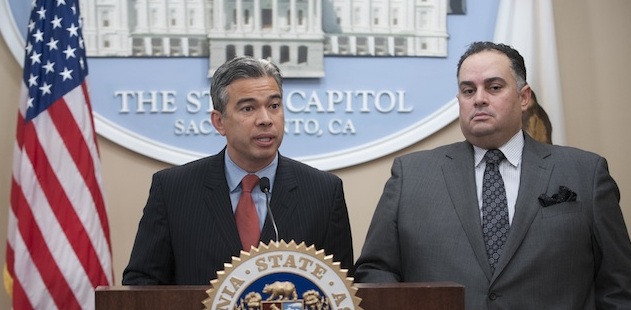
Assembly Speaker John Perez, right, and Assemblyman Rob Bonta
CalSTRS lacks the power to set rates, needing legislation instead. And for a half dozen years, the CalSTRS plea for a rate increase went unheeded by the Legislature as the state struggled with deep deficits.
The first sign of movement came two years ago when a legislative resolution asked CalSTRS to meet with stakeholders and present three alternatives for a long-range funding solution. A two-house legislative committee held a hearing last year.
Then the new state budget proposed by Brown last month called for talks with teachers, school districts and others to work out a rate-hike plan. A plan was not expected to be enacted until fiscal 2015-16 and then phased in over several years.
“If the Legislature can do it this year, fine,” Brown told reporters. “I think it’s going to take a little longer.”
Last week Speaker Perez, D-Los Angeles, held a news conference with Assemblyman Rob Bonta, D-Oakland, the retirement committee chairman, to announce a push to enact a CalSTRS rate-hike plan this year.
“Further delays only mean further costs and further exposure for the state’s general fund,” said Perez. He is termed out of the Legislature and running for state controller, an office that has a seat on the CalSTRS and CalPERS boards.
Bonta said the Assembly Public Employees, Retirement and Social Security Committee plans to hold a hearing on CalSTRS funding Feb. 19. He said later hearings will deal with the Proposition 98 school-funding guarantee and teacher vested rights.
The speaker said the contribution increase should be shared among the three current CalSTRS contributors. The state is contributing about 5 percent of pay, school districts and community colleges 8.25 percent of pay, and teachers 8 percent of pay.
Perez also said the plan should aim at 100 percent funding. Some think 80 percent is adequate. In past desperation, some suggested rate-hike scenarios simply aimed to extend the point at which CalSTRS runs out of money, now projected at about 30 years.
Last year the estimate of the rate hike needed to fully fund CalSTRS pensions already earned over the next 30 years was 15.1 percent of pay or about $4.5 billion a year, nearly doubling the $6 billion received from current rates.
Strong CalSTRS investment earnings last fiscal year (13.8 percent), nearly twice the 7.5 percent target, dropped the estimate of the immediate rate hike needed to project full funding to 14.2 percent or $4.2 billion a year.
A new actuarial report from Milliman scheduled to be presented to the CalSTRS board today looks at the “impact of further delay in funding.” A two-year delay increases the full-funding rate hike by at least 0.9 percent of pay or $15 billion over 30 years.
The nonpartisan Legislative Analyst’s Office estimated that if a plan to fully fund CalSTRS in 30 years began now, with 3 percent of pay added each year, a “ramp up” of rates over several years would have to reach more than $5 billion a year.
“In general, the most important action the state can take to minimize the long-term cost of addressing CalSTRS’ liabilities is to act quickly to increase funding to the system from some combination of state, district, and teacher sources,” the LAO said in a brief issued yesterday.
Reporter Ed Mendel covered the Capitol in Sacramento for nearly three decades, most recently for the San Diego Union-Tribune. More stories are at Calpensions.com. Posted 6 Feb 14
 Calpensions